
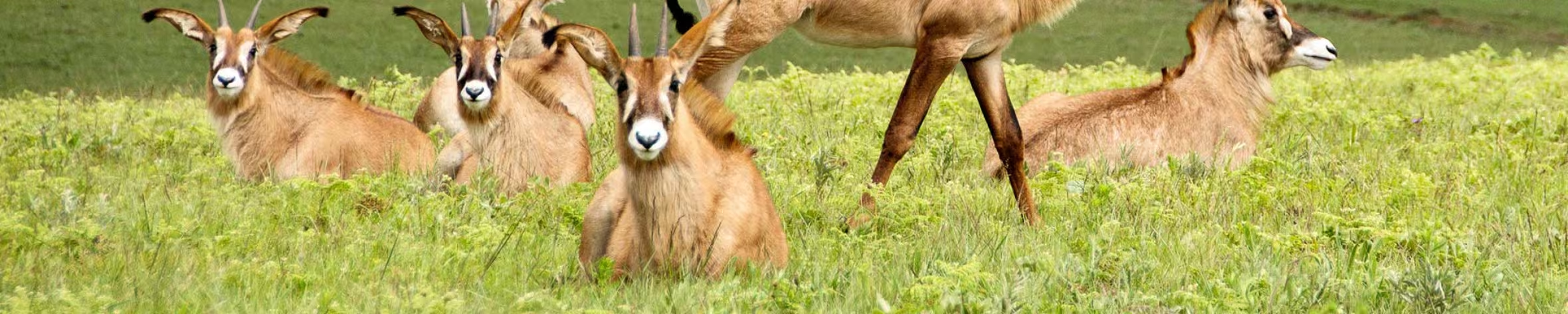
Nyika National Park, Malawi’s largest national park, protects a vast highland plateau of rolling grassland and heather interspersed with forest and pine plantations. Very different in character from most other African parks, it is notable for its wild mountain scenery, immense horizons and thrilling sense of isolation. Although Nyika isn’t primarily a destination, a good amount of wildlife can be seen on and guided walks, and birds and wildflowers are abundant.
-
 Best Time To Go
- November to May (More animals and pleasant temperatures)
-
 High Season
- July to October (Never busy, but high-season rates apply)
-
 Size
Size
- 3,134km² / 1,210mi²
-
 Altitude
-
590-2,482m /1,936-8,143ft
 View Photos
 View Photos
+17
Photos
View Photos
+17
Photos
Pros & Cons
- Beautiful mountain scenery
- Well-organized lodge and attractive cottages and campsite
- Activities include , walks, mountain biking and fishing
- The only place in Malawi where leopards are regularly seen
- Common wildlife includes zebra, and
- Superb bird watching includes a long list of local specials
- The remote highland location offers stunning night skies
- Very uncrowded and unspoiled
- Limited accommodations
- Not good for viewing
- Access and internal roads ideally require a high-clearance 4x4 vehicle
- Very cold in winter
Wildlife
Nyika NP is not a conventional wildlife destination. Although elephants inhabit the lower slopes of the plateau and lions occasionally cross over from Zambia, the only member of the encountered with any regularity is the leopard, which is quite often glimpsed on . is abundant, and you should also see plenty of , , , , and . Also look out for and .
More about Nyika’s wildlifeScenery
Nyika Plateau is one of the largest areas of high montane (mountain) grassland left in Africa. The rolling grasslands are studded with gigantic granite domes and pockets of forest, while the exotic pine plantations evoke the Scottish Highlands. Of note is the abundance of wildflowers, especially the roughly 200 orchid species that flower in January and February, of which 11 are to Nyika.
Activities
Guided are offered by the lodge, but they can also be undertaken on a self-drive basis in a good 4x4 vehicle. Although the variety of large mammals is limited, the vast scenery offers a great opportunity to photograph zebra, and in their natural habitat. Leopard, , and other small carnivores are often seen on . Guided walks and mountain biking are also on offer, as well as bird-watching excursions in the forest.
Weather & Climate
Due to its high altitude, Nyika Plateau (the area of the park accessible to tourists) has a temperate climate. Temperatures are relatively uniform throughout the year, but there is a peak in October/November before the rains arrive. The yearly rainfall occurs almost entirely during the Wet season (November to April). The Dry season (May to October) is colder, and from June to August it can be bitterly cold at night.
More about the weather and climateBest Time To Visit
The best time to visit Nyika Plateau is during the warmer months, from November to May. At this time, fair weather makes morning and afternoon more pleasant. This differs from other parks in the region because of the plateau’s high altitude and cold temperatures.
More about the best time to visit